Just a place for me to say what's on my mind. This often takes the form of reviews.
Friday, August 17, 2012
Binary Domain review
The first thing I heard about Binary Domain was that squad members might refuse to take orders if they didn't trust you. I was mildly intrigued, but when I heard more about the story I started to get quite interested. The plot reminded me of some Anime movies I had seen (Vexille comes to mind), but I didn't feel that made it derivative, rather I was curious to see it's treatment of the subject matter.
Let me start by saying the story doesn't disappoint. It manages to function as both the driving force for the game, and as a great story in it's own right. It gives you excellent reasons for being where you are and doing what you're doing every step of the way without feeling either padded or too short. You're encouraged to care about your teammates opinions of you, and to care what happens to them. It has some unexpected twists, and some moments that genuinely keep you guessing. And what's more, the story is not black-and-white, raising some questions that aren't easily answered.
The characters are mostly very well developed, with excellent dialogue and voice acting and good facial animation really helping to bring them all to life. There's quite a large and varied cast, and by the end of it I was quite fond of every one of my unit members. This is actually core to the game itself, with your interaction with your teammates being one of the main gameplay mechanics.
You see, each of your companions has a different degree of trust in you. The more they trust you, the more likely they are to follow your orders in battle. You earn or lose their trust based on what you say to them, and on how well you do in combat. This not only encourages you to think about how you use them in a fight, it also means you pay more attention to what they say and what they expect of you, so you get to know them better than you otherwise might. It's an ambitious idea, and it did work for me in that I found myself quite invested in all the characters, but it does have some problems.
First of all, communication is achieved through a microphone and voice recognition. I understand the idea; to be able to actually talk to them and hear them reply, but in practice it doesn't quite work. You see, it's functionally impossible for the game to be able to recognise and deal with every sentence we might want to say (it's still a little early for that...), so it has to limit your speech options. Now, in a game like Mass Effect, those options will be displayed on screen for you to pick one. But it doesn't make sense here to show you a selection of sentences; apart from ruining the immersion you're going for by having people read something out rather than respond naturally, the player would most likely prefer to simply press a button to select an option rather than reading out a long sentence he's already read to himself. So instead the game gives you a limited set of accepted responses to use, things like "yes", "no", "dammit", "thanks", "I got it", and so on. The idea I believe is that initially you'll press the button that shows you your choices then speak one, but eventually you'll have an idea of what they are and so you'll just respond naturally.
But this limited selection is a problem. Your teammates dialogue is quite complex and varied, at least enough that answering everything with "OK", "Thanks" or "Dammit" doesn't feel natural. To me, the shortcomings of voice recognition here made it feel more like a barrier to communication rather than an aid. Without the compromises needed for voice recognition, the game might have been able to offer more detailed dialogue options, and would be able to vary the options more based on the situation.
However, I should clarify that I decided early on I didn't feel like talking into the microphone (maybe it was because I was checking my dialogue options all the time anyway, or maybe I felt silly talking at the wrong times when the game wasn't expecting it), so I turned it off and made manual dialogue selections. Perhaps if I had stuck with it I would have gotten used to the limited options and it would have felt more natural?
I imagine it would help a lot in combat anyway. I did not cooperate with my teammates very well, one reason being the limited number of voice commands I was initially presented with, but the other was obviously that I was usually too busy to open the dialogue selection - a problem I wouldn't have had if I had been using verbal commands. I regret that now, and I'm considering giving the game another try with voice recognition on, to see if I can figure out how to make the most of it in actual combat. I'm not sure how well it will work considering what I really want them to do is usually rather more complex than I expect them to understand, like "You go left I'll go right" or maybe "I'll keep it busy while you shoot it", or perhaps "Distract the giant gorilla robot while I reload the big gun! No, don't lead it towards me, go the other way! What the hell are you doing? God, why are you so useless!". Ah-hem. Actually, it's probably a good thing that they can't understand everything I say.
Despite this issue, I thought it a very interesting system that was well integrated into the game. I found myself trying to understand what each character was really like, what really made them tick, so I could select the best responses to endear myself to each of them. Then I realised I was so trying so hard to earn their approval that I was saying what I thought they wanted to hear rather than what I wanted to say, or what I thought my character should or would say. How many games can make you say that?
Actually I'm quite impressed by how much of a difference the trust mechanics made to how much I care about other characters in the game. I can't help but wonder what difference it would have made if the main character was a silent protagonist. As it is, his own personality and dialogue are an important part of the story, but in a different type of game would it have led to an even stronger connection with the characters? It's an intriguing idea.
The graphics are good, though not amazing. Generally environments are clear and detailed without being noisy, perfectly fitting to the futuristic setting while looking good and running at a solid framerate even with a decent number of enemies rushing forwards. In fact some larger enemies and set pieces look very impressive, and as I alluded to before the human characters look great, with plenty of personality and detail. Worth mentioning is that it's quite easy to spot enemies, even when they're behind cover (you can see my Rage review for the full rant, but suffice to say I find enemies tend to blend into the environment in many games these days, making them hard to spot).
The rest of the game is a standard, though well executed, third-person shooter. The weapons are nothing special, with the normal assortment of assault rifles, machine guns, sniper rifles, shotguns, and missile launchers. Unusually there's a variety of each, which is a rather nice change. You can carry several weapons; specifically you always have a pistol, your own special assault rifle, and one other weapon, plus an occasional extra heavy weapon. Your teammates each have a specific weapon, such as a heavy machine gun or sniper rifle, which of course controls what they are best at and hence how you should use them on the battlefield. Your assault rifle has a special secondary 'burst' weapon, which comes in handy against bunched up groups of enemies or some of the larger models. Pistols are weak but have infinite ammo, which is a good thing as you don't want to get into a punch-up with a robot if you can avoid it. Other weapons work as you would expect, but some are more fun to use than others.
Overall firing the guns don't give you as much of a feeling of impact as in some games (coughAlanWakecough), but this is made up for by the enemies. Robots lose armour and body parts to sustained fire, jerking and sparking as you lay into them. What's more they try to continue to function despite the damage: blast a robot's gun arm off and they will run over to the fallen weapon and pick it up with their other hand. Knock them off their feet and they'll come crawling towards you, hanging on to your legs and leaving you vulnerable as you try to shoot them off. But blow their head off and they get confused and start attacking their friends, drawing their fire. You soon learn to recognise and enjoy the distinctive 'ping' of a robot's head flying off, as it's an effective tactic when your enemies are dug in.
I did have some trouble with the cover system and related context sensitive controls; occasionally I would sprint into the open when I was trying to snap to cover, and sometimes traversing complex terrain while in a hurry could be frustrating. It didn't affect me very often though; the truth is these issues are common to third person shooters, Binary Domain is no worse than most.
As is common in such games, you and your teammates can survive for a while after being downed, giving others time to get to you and heal you with a medikit. Binary Domain has a more involved system, however. When knocked down a teammate will ask if you need help or not, you can either accept their help or heal yourself. Likewise, when a teammate goes down another may ask if he should help them, you can of course chose to do it yourself. Medikits are limited (you can see how many each of your friends is carrying, but for some reason you can't swap them between people), so part of the issue is deciding how to keep the supply distributed. But the real advantage of the system is that it makes you more involved with your teammates during a battle. Do you rush over and help them yourself when they go down, or do you expect them to take care of themselves and not bother you while you're busy gunning down robots? Do you accept their help when you're wounded, or is it important to you to carry your own weight? It's all part of the connection you form with the characters.
You can upgrade both your own primary weapon and those of your teammates. There's also some enhancement modules you can buy to improve a character's health or let them carry an extra medikit or the like. Neither system is terribly deep, but together they do add something to the team-centric focus of the game. Do you spend your money on yourself or your teammates? How best to equip them? Will you display favouritism by spending more money on some characters than others? For example, one of my teammates annoyed me once by telling me off after a tough fight, so I removed all their enhancement modules as a way of exacting some small measure of personal revenge. I would have liked to see the enhancement system especially fleshed out a little, but the weapon upgrades certainly work well: even though I spent a lot on my teammates, near the end of the game my assault rifle had the power and ammo capacity of a heavy machine gun while being accurate, controllable, and still quick to reload.
Even in hard mode you can take a fair bit of fire without going down, and fortunately the screen only darkens and reddens at the edges and never the center (not while you're still standing anyway), which I am extremely grateful for - if you've read many of my reviews you probably know how much I hate the "one bullet and you're blind" nonsense that plagues modern shooters. This means that it's actually possible sometimes to walk towards enemies, laying down a barrage of fire, without dying. That's not to say it's too easy, only that you don't have to spend the whole game cowering behind cover; I found the game more dynamic and exciting than most cover-based shooters I've played. In fact I had more fun than I initially expected to, walking forwards laying down a stream of bullets and watching the robots in front of me getting blown apart bit by bit.
Worthy of mention are the game's boss battles and other set pieces, which strike an excellent balance of visual punch and player interaction. Some of those boss robots are immense, and unlike many games beating them isn't as simple as learning a couple of patterns and hitting them a couple of times in the right spot - these guys can take a hell of a lot of abuse and avoiding them isn't easy, which makes each fight a real battle.
The set pieces, cut scenes, and slower moments of gameplay do a good job of giving the characters personality and generally mixing things up and enhancing the feeling of adventure and danger. When I reached the end of the game I felt as if I had done more than just shoot through lots of robots, I felt as if I had been through a hell of an adventure, in fact I felt as if it was amazing that we had gotten so far. That's certainly not something I can say for every game I play.
I'm going to give it a 9/10. Yes, some of the squad mechanics didn't work so well for me, but I still had far more fun with it than most games I play these days, especially third person shooters.
Thursday, August 16, 2012
Eat Lead review
I recently picked up some old games I missed first time, including Matt Hazard - or rather, Eat Lead: The Return Of Matt Hazard, to give it it's full title. While the reviews I read did not speak too highly of it, I thought it looked like a game with a sense of humour, which is exactly what I wanted.
It goes without saying that humour is subjective, so I can only speak for myself when I say that I found Eat Lead to be entertaining. The game is very self-aware - while it doesn't exactly break the fourth wall, Matt Hazard knows he's playing a videogame, and most of the humour might be considered "in-jokes" - at one point Matt visits a familiar looking carpenter in a factory that produces all the exploding barrels used in videogames, to give an example.
You might not think it very witty, or you might appreciate the nod to the fact that so many games try to hard to be so realistic and to justify every little detail, when the truth is we all know none of this is real, it's just bright lights dancing across a screen for our entertainment. Personally, I thinks it's nice to see a game that remembers why we're all here: to have fun.
And that's exactly what Eat Lead tries to do, by taking advantage of this self awareness to liberate itself from some of the rules that modern videogames impose on themselves. Zombies battle alongside space marines and Russian soldiers in seedy night clubs as you gun them down with super-soakers and plasma pistols. You might be in a Japanese restaurant one minute, then walk through a door and find yourself in a Soviet nuclear missile silo. Saloon doors open in mid-air to admit gunslinging cowboys while Nazi "Waferthin" troops seems to appear out of nowhere as their 2D sprites turn to face the camera.
You will have noticed that I said "tries". Unfortunately Eat Lead's gameplay is mediocre at best. It's a basic cover-based third person shooter, and never anything more. The weapons aren't particularly satisfying to use, and sadly the most unique weapon in the game was a rifle that could be charged up for a more powerful shot. There's a few special abilities and temporary power-ups, but they don't really add anything to the game. What's worse, for some reason I found aiming very hard to do, at least at speed; achieving headshots at distant targets hiding behind cover with a humble pistol was far easier than trying to hit an exposed enemy right in front of you with an assault rifle if that enemy wasn't standing completely still.
Strangely, despite the mediocre gunplay, Eat Lead has the best implementation of a cover system that I've seen. It's quick and easy to move between and around cover without exposing yourself - something that's not true of some high-profile big-budget third person shooters I've played recently - and there's even a streamlined, if not really necessary, "point-and-click" cover system for advancing into cover. What's more, this is the only game I've ever played where you could smoothly look or aim all the way around your position in cover without the camera fighting you, which is a very nice feature.
While enemies are visually interesting, there's very little different between them in game terms. Zombies spring up where normal enemies die, Nazis disappear by turning away from the camera after taking a few rounds and can't be killed until they turn back, space marines are very resilient, fembots have to be finished off up-close. That's about it. Actual level design doesn't vary much either, as you can imagine it can all get a little repetitive. It's a shame that the same creativity that went into the writing wasn't applied to the actual game design.
Despite these issues, I actually found the story and characters entertaining enough to keep me playing all the way through. Little moments kept things interesting, like a character from a different type of game who spoke with speech bubbles that Matt has to click on to advance through, or a part when I genuinely wasn't sure if the game had glitched or not (it hadn't). Not wanting to spoil anything, but... gunning down developers who didn't know how to play their own game? Genius!
In the end I've settled on a 6/10. If the controls had been just a little better, or the gameplay just a little more creative, I might have given it a higher score. Unfortunately it takes more than a sense of humour to make a good game.
Thursday, August 9, 2012
Rage review
I have spoken previously about how impressed I was with the Rage demo, so it should come as no surprise that I bought and played through the full game. You'll forgive me I hope if this review is even more long-winded than usual.
I played Rage on the X-Box 360. Now, the X-Box is a console with no lack of first person shooters, however most of these in recent times could be termed "console shooters". That's not to say that you can't get these types of shooters on the PC, but simply that they've been designed to work better for consoles and console players. This comes down to factors like the controller, the use of a television some distance from the player rather than a high resolution monitor a mere arm's length away, and perhaps the kind of players who predominantly play on one system or the other and the kind of experience they are looking for. My point is that on the PC, Rage may not stand out. But on the X-Box, it really does.
Lets start with the graphics. These are the best graphics I have ever seen on a console, at least in a first person shooter. I don't know if Rage's graphical engine is more powerful than, say, Crisis 2, and there's games with unique art styles or full of beautiful imagery that are more visually pleasing. But Rage's combination of high resolution graphics and unwaveringly high frame rate just make it a joy to play. But there's more to it than that. The environments are bright and detailed without being too noisy, and most importantly it's never hard to see what's happening.
Now, I'm going to go off on a tangent for a moment, so please bear with me. As you will know if you've glanced at my other blog, I occasionally paint Warhammer miniatures. When I first started, I obviously painted things in simple primary colours; to paint a model I would probably use one shade of blue, one shade of red, and some pure black. But reading painting tutorials and looking at pictures of competition-winning models online, I slowly started to understand a more about the use of colour. I saw how analogous colours that softly blend into each other are so visually pleasing, blues blending into greens or reds into yellows, that sort of thing. I saw whole models that were painted entirely in different shades of the same colour that looked amazing.
So I started to try to use more uniform colour palettes, to use common "wavelengths" in different colours. The idea (at least as I see it) is that a colour is a mix of different wavelengths of light, so by having different colours that share some wavelengths they would better tie together. For example I would paint two different colours, say an orange and a light brown, then stain them both with the same reddish wash to introduce those shared wavelengths. I'm sure I'm doing an awful job of explaining this and any artists reading this are shaking their heads at how ignorant I am about colour theory, but I'm not an artist, I don't know much about this stuff except what I've recently started to learn from experience. What I found was that my models started to look too uniform; they lacked contrast and definition. That's not necessarily to say that they looked bad, but it wasn't easy to make out the individual parts of the model because it all tended to blend together. So now I'm trying to find a balance; colours that look like they belong together but are distinct enough that the model's details are easy to make out at a glance.
The reason I'm talking about this is because I think games are going through the same process. The limitations of the technology meant that games started with simple, brightly coloured sprites. As the technology has progressed and the art started to mature, certain artistic sensibilities started to appear. Bright primary colours were replaced with more realistic muted tones and uniform colour palettes, aided by the use of post rendering filters to tinge the entire screen with that shared wavelength. Take for example this screenshot of Killzone 2:
![]() |
| A veritable cornucopia of colour. |
Now, this all creates some very pretty screenshots. However, a problem I have found is that I sometimes have great difficulty actually reading the screen. I literally can't see the enemies much of the time. It may sound silly when you look at a screenshot, and it's my understanding that not everyone has this problem, but when the bullets are flying, my screen is filled with muzzle flash and smoke and is being coloured red by the damage indicator and blurred by motion blur as I'm running and turning and so on, in that split second that I need to identify and target my enemies, I can't seem to make out the grey soldiers from the grey ground, grey walls, and grey sky. This is sometimes made worse by busy textures and unhelpful lighting. And of course there's the military shooters, where it's dark, the bombed out environments are incredibly noisy, your enemies are wearing camo that's the same colour as the environment, they're almost completely behind cover, and your screen goes dark red as soon as you get hit.
But if Rage is any indication, the games industry is starting to understand the problem. Whether it was under the harsh desert sun or in a dingy rubbish-filled sewer pipe, I never had any trouble spotting enemies. Part of this is thanks to the high frame rate and texture resolution, but that's certainly not the whole story. I can't tell you what's really responsible because I don't really know, but even though environments are very detailed and non-uniform, filled with piled up garbage and the like, and your enemies are similarly clothed in a patchwork of detailed, mismatched garments, and they spend plenty of time hiding behind cover, they aren't hard to see.
![]() |
| Looks good AND I can see the enemies. |
Artistically the imagery is fitting. Desert wastes hold both crumbling abandoned cities and sleek, high-tech Authority installations. Inhabitants, both friend and foe, wear random pieces of shabby clothing and protective gear and carry rusted old makeshift weaponry, while Authority enforcers wear head-to-toe protective suits and carry shiny new guns and energy weapons.
The graphics and art style, therefore, are both visually impressive and perfectly suited to the game. You do need a significant install to the hard drive for best results, and if you look there's occasionally some noticeable texture streaming as you turn the camera, but I personally never found these to be a problem, not even a minor distraction.
Of course, graphics alone don't make a game. Happily, Rage has some of the best gameplay I've experienced on a console shooter. The game is fast, the controls as extremely precise and responsive, weapons are satisfying to shoot, as is the way enemies react to being shot. You can advance slowly and pick enemies off from a distance or run and gun up close and personal. Enemies are no pushovers, but regenerating health and the defibrillator makes it forgiving while letting you know that you're making mistakes, there's challenging sections but enough tools at your disposable to fight your way through so you should never get stuck.
The speed of the game reminds me of Unreal Tournament 3, which of course is a port of a PC shooter. Unreal was very fast paced, characters moved quickly and smoothly leading to very intense high-speed combat. It's worth noting that Unreal did not have an "aim" button, and it didn't need it. Rage does have the aim button, but you can manage pretty well without it if you want to, which is a testament to just how well the controls work.
Unlike many modern shooters you're not limited in the number of weapons you can carry. You can't just pick them off your victims corpses however; like older games you buy or unlock weapons as the game progresses, at which point they are yours to use at any time. I quite like this; no more having to constantly stop and decide which of the weapons scattered around the floor to use until the next time you run out of ammo.
The weapons themselves are mostly standard; pistol, shotgun, assault rifle, sniper rifle, missile launcher, minigun, and of course the BFG. Perhaps the most interesting weapon is actually the crossbow. In addition to regular bolts, which are powerful and silent, it can also fire charged bolts for electrocuting multiple enemies standing in water, mind control bolts, and sticks of dynamite. Having said that, my pick for the most enjoyable weapon/ammo combination in the game is the shotgun with exploding slugs. I can't really describe how much impact this thing has, it's just devastating.
In addition to your firearms, there's a range of secondary items which include bandages, RC car bombs, automated machine gun turrets, and even small machine gun droids that fight alongside you. All in all, there's a satisfying range of options for dealing out death.
All these weapons, ammo types, and tools would get confusing to use in actual battle, but luckily there's a very intelligent control setup for switching between them. Worth mentioning is that holding the weapon change button open the weapon wheel, but tapping it just switches to the next weapon. With a little thought you can arrange weapons to make the most of this, for example you can put the shotgun after the sniper rifle so if you're using the sniper rifle against a distant foe when suddenly someone pops up right beside you, one tap will whip out the shotgun for some fast close-range power.
There's some scope for upgrading weapons, but this is very minimal and almost feels like an afterthought, without even a dedicated interface in the equipment menu. For example, once you by a monocular you can't "unequip" it, so you'll always zoom in when aiming your pistol. More developed is the crafting system, which allows you to craft tools and even fancy ammunition from random junk you can pick up in levels or buy in shops. You need recipes for this, which you find, buy or unlock as the game progresses. It's an interesting diversion, if you wish you can ignore it completely and simply sell any junk you pick up, it's entirely up to you. It's worth mentioning that you can buy or craft most types of ammunition, so you don't have to be conservative with the fun stuff that way some games force you to be.
There's a good variety of enemies, with bandits, mutants, and soldiers of various types. Some will hang back behind cover, but other will charge forward, yelling and screaming, climbing up and swinging and doing whatever it takes to reach you - it's all very impressive, as well as somewhat scary. The way they react to being shot is also very cool; the more reserved enemies scramble for cover while the more aggressive ones stumble but try to keep their feet and maintain their forwards momentum, overall it lends weight to your shots and just makes the experience more engaging.
The game also features some driving segments and side missions. These include racing and vehicular combat, plus you'll have to fight off bandits when driving to and from mission locations. You pick up several vehicles over the course of the game, these can be upgraded using credits won in races. I am not a particular fan of driving games, but I found the racing and combat to be easy to get to grips with and fairly enjoyable. It might not be for fans of more realistic racing games, and unfortunately for them there's no getting away from spending a fair amount of time driving. For everyone else, it helps to break up the action segments and stops the game from becoming repetitive.
Which is not a bad thing as the main story has a decent run-time; It took me about 14 hours to finish Rage, at least according to my last save game. There's a fair number of side missions that I didn't do, and I didn't really get into the racing, so there easily several more hours worth of gameplay in there, and I'm not even considering multiplayer. So it's good that there's ways to take a break from the killing; in addition to driving there's a few minigames to try. The most involved of these is the card game; in addition to the starter deck, you can find cards scattered around levels. The rules are simple, which makes it easy to get in to and quick to play, but after you've played a few rounds you realise that you don't have much control over the game itself, all the skill is in building the deck. It's entertaining while it lasts though.
So the graphics and gameplay are great, the game is a good length and there's a fair variety of things to do. Is there anything wrong with the game? Well, it does have a few weaknesses. Perhaps the most obvious is the story. The basic plot isn't very well told; it's post-apocalypse, there's these arcs with people from the past in them and something about meteors and the only surviving government is actually evil. Or something.
The story never really gives us very much substance. Despite the good voice acting I never got to know any of the characters enough to care about them. The Authority are supposed to be evil, but that doesn't really tell us very much about them, and what's worse is that they are faceless. We never even see their leader, General Cross, we only hear him mentioned. It just felt a bit distant to me.
I never felt that I had a personal stake in events, I was just doing what random people asked me to do. This is partly a result of playing a silent protagonist, but other games have overcome this problem and made the fight feel personal - take Singularity for example, where I felt a personal responsibility for everything that was happening. Rage just never managed to give me that sense of personal motivation.
Furthermore, the game felt as though it ended too soon. I understand leaving narrative hooks for a sequel, but this felt almost unfinished. I would have at least expected a showdown with General Cross, even if it wasn't a final showdown. In fact the end-of-game battle, while intense, was a little non-memorable as it was against the same enemies you had been fighting the entire level. There's only a handful of what might be termed "boss encounters" in the game, and these peak about halfway.
Another thing that I wasn't personally a fan of was the very linear level structure. Which you have a large open world to drive around in and towns you can wander around and explore for a while, once you arrive at a mission you are typically just walking down a single corridor. A very thematic, decorated corridor with plenty of twists and turns, but a nevertheless a narrow corridor with absolutely no branches. It's not such a bad thing, but in this case it feels a little strange because of how it contrasts with the greater freedom you have outside of the missions, it would have been nice to have more open levels that you traverse rather than a single path that you travel.
The levels also felt somewhat static. It might just be me, but there's some games where the levels feel more solid and interactive, almost more real. Some of this has to do with physics objects that react to your presence or to being shot at, some of it might be that bounding boxes more closely follow the visible geometry, so when you jump around you interact with the environment the way you expect to. But in Rage, I felt as if the levels were less real, less solid, more of a backdrop that I couldn't effect or interact with. Bounding boxes seemed to be more general; a pile of garbage felt more like a featureless wall than an actual collection of different objects when I would walk into or along it. I suspect this is a sacrifice made for the sake of the high framerate and graphical quality, in which case it's probably a sacrifice well worth making. It's never a problem, but when there's games these days with fully destructible environments I felt that it was worth mentioning.
So after all that rambling on, what's the verdict? I give it 9/10, it focusses on what's important and as a result is easily one of the best first person shooters I've played on a console.
Monday, July 30, 2012
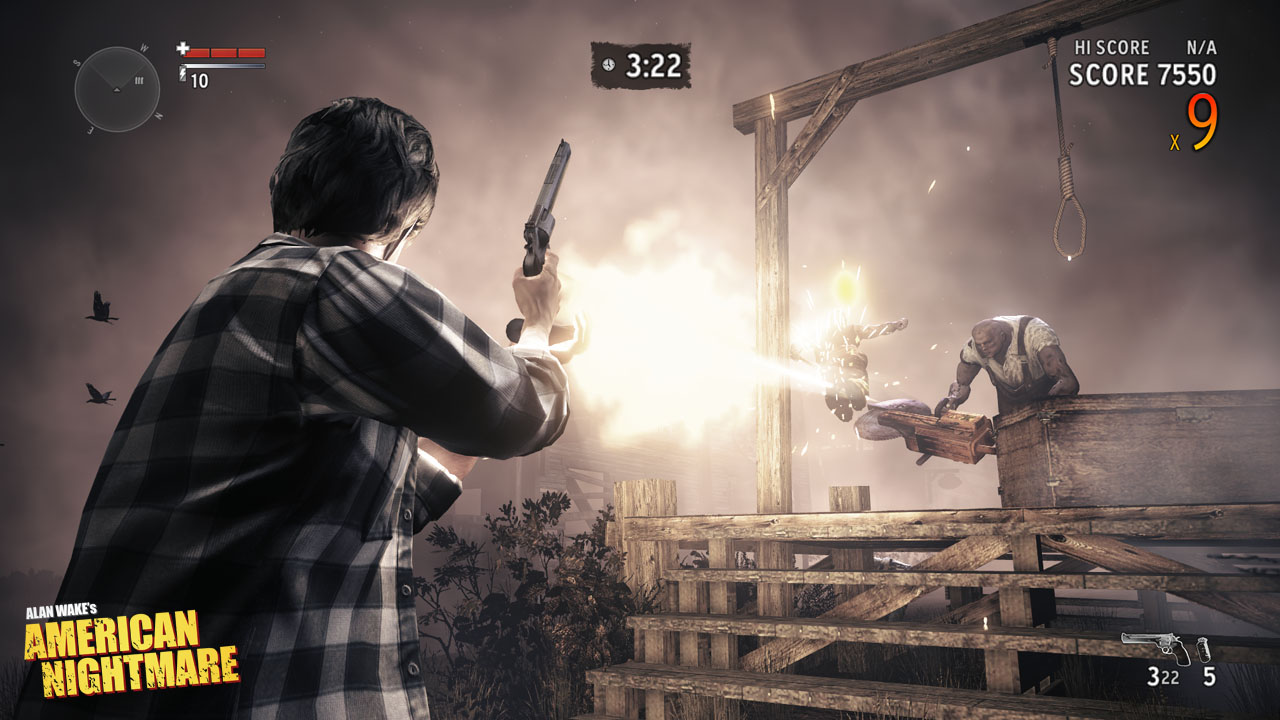
Alan Wake's American Nightmare review
After I finished the extra Alan Wake episodes, my appetite was whetted and I decided to roll straight into American Nightmare. This is not a true sequel; to continue the TV series comparison from my previous Alan Wake reviews, American Nightmare is a lot like a spin-off movie. Longer than the specials and with some changes to the basic formula, it has it's own self-contained story that's canon and does advance the plot, but is not necessarily required viewing.
American Nightmare has two game modes: story and arcade. The basic gameplay is mostly the same as before, but with some tweaks and added features. Rather than describe the core gameplay again, I'll focus mainly on the changes in this iteration of the series. If you're not very familiar with Alan Wake you might want to read my original description of the game.
Perhaps the biggest change to the formula is the more open-world approach in the story mode. While previously Alan Wake had very linear levels, American Nightmare has open environments across which you travel back and forth to achieve objectives. The game is still linear though, with no side missions or optional objectives (with the exception of collecting manuscript pages), as a result the open world, and certain story elements that I won't spoil here, might come across as cost-cutting measures.
This may be the case, but personally I prefer to view them as an attempt to provide the player with as much gameplay as possible for the budget. The story mode took me around 8 hours to complete, which is a respectable run time for a campaign these days. Add to that the excellent arcade mode, and there's a lot of fun to be had for something that's not a full game. Besides, the story does a great job of giving you a reason to keep backtracking, and I found it interesting to see the changes each time I revisited a familiar location.
Speaking of the story, Alan now has a new nemesis: Mr. Scratch. He is a far more personal foe in that he's essentially an evil doppelgänger. It might be a bit of a cliché, but that's because it works, and I found it to be very well handled here. This is in no small part thanks to Matthew Porretta putting in a brilliant performance as the grim Alan and the morbidly entertaining psychopath Scratch. Oh, and I love how they actually say Scratch's name in the game.
The main plot seems a bit aimless on the surface, and arguably doesn't make much sense outside of the context of the Alan Wake framework; that is, it makes sense in that literary devices drive the narrative. Why a radio telescope? Because it's a good metaphor for trying to send a message from very far away. Remember that in Alan Wake, writing is Alan's weapon; it's the story being written that shapes the reality. The story needs to be dramatic, so dramatic things happen. Yes, it can be very abstract, in fact it could even be viewed as lazy game design - you need to play a music CD in order to have an asteroid knock a satellite out of orbit?
But that's missing the point. Alan Wake has always been about blurring the line between reality and fiction; in the story that manifests as Alan directing reality with his writing. In the game that manifests as the same gameplay elements that work for the game by making it more dramatic, make sense in the story for the same reason. Why is there an assault rifle leaning against the wall here? Because Alan Wake wrote it in to make the story more dramatic and give the protagonist, himself, and advantage. Because the Remedy put it there to make the game more dramatic and give us, the players, an advantage. There's no need to stretch credibility to try to set the scene; setting the scene is now part of the narrative.
Much of the real meat of the story is told in radio and television broadcasts. The player can stand and listen or simply walk past if he chooses, but I would recommend listening in as these are actually more meaningful to Alan than his interaction with the in-game characters, who are all strangers who don't do very much other than move the plot forwards and perhaps help us see how much Alan has changed. On the radio we hear familiar voices of Alan's friends talking about how they have dealt with his disappearance, an on the television we see Mr. Scratch taunting Alan and giving us a glimpse of the atrocities he commits.
I mentioned that Alan has changed. He's not wasting any more time asking questions and wondering what's happening, he knows what's happening and what he has to do. His time fighting the Dark Presence has made him harder, tougher. It's a subtle thing I think, but I appreciate it. Alan doesn't whine or complain, he just gets on with it, and I like that. That's not to say he's emotionally dead; he does talk about his past, his old friends, about what's happened to him. His own character, the mistakes he's made, are still central to the plot. It's just that he's accepted the situation and he knows his only option is to fight.
The changes to the combat are relatively small but have some rather significant consequences. First of all, your flashlight will not burn off a Taken's protective coat of darkness without focussing. This was a huge deal for me, as I had developed a habit of momentarily dazzling Taken with a burst of focussed light to slow them down, then burning off their darkness with regular light while backing away. This meant I almost never needed to change batteries in my flashlight. The new system is balanced somewhat as the flashlight recharges more quickly, and now that I've gotten used to it I think it's a change for the better. It feels more like this is how it should work, and it makes the combat more tense and challenging.
Health works differently too. Previously health would regenerate slowly, or more rapidly when standing in a "safe haven". Now Alan's health bar is split into three sections, as long as there is some health in the current section it will regenerate, but once the section is gone it won't come back until you reach a safe haven. This is complicated by the fact that safe havens are temporarily exhausted once used, so you can't keep running in an out of one during a battle. Altogether this creates a less forgiving health system, which again ramps up the tension and difficulty.
There's a much greater variety of Taken this time around. One type of enemy can transform into a flock of birds in order to confuse and flank you. Another splits into two smaller enemies when shot. There's a misshapen giant who wields a massive buzz saw, and a one particularly annoying specimen hangs well back and throws grenades with surprising accuracy. What's more, they seem to me to be more intelligent now. The Taken have always liked popping out of the woodwork behind you, but that was about the extent of their guile, and once they had revealed themselves they would pretty much just come straight at you. Now, however, they continually try to flank you, limiting your mobility and forcing you to keep splitting your attention between multiple vectors. You have to keep track of multiple targets at once, and it becomes a nerve-wracking balancing act of splitting your fire to keep them away and focussing it to take them out.
With the Taken posing more of a threat, it's good that you have more ways to deal with them. The game features far more weapons than before, some of which are much more powerful. I was impressed to find that every single one, from the humble nail gun to the combat shotgun, was satisfying to use in some way. There's also some degree of balance; the assault rifle uses up ammunition quickly, the crossbow is extremely powerful but has a very slow fire rate, the combat shotgun is fast and powerful but takes a long time to reload.
Weapons can be unlocked by collecting manuscript pages as you progress through the game, and once unlocked are available in arcade mode. Luckily you have now have a minimap that gives you a hint when there's a manuscript page close by, so hunting them down isn't too hard, and with the open world system it's slightly less distracting than it was in the original game.
There's now ammunition restock stations scattered around levels; these will fill you up on ammunition for the weapons you are currently carrying. They can only be used once every few minutes, but this isn't much of an issue in the story mode as there's no time pressure anyway. This is about the only change that I didn't think worked very well in the story mode, as I've always considered the scarcity of ammunition to be an important factor in a survival-horror game. However, given the problems of trying to provide a balanced supply of ammunition in an open world game with a large variety of weapons, it was probably a necessary compromise. At least this way you don't have to run around exploring if you'd rather just get on with the story.
The arcade mode does away with all narrative concerns and focus on pure combat. It takes the form of arenas with waves of enemies spawning in. Your goal is to survive ten minutes and rack up a high score. You have a combo meter that builds up as you kill Taken but is instantly reset as soon as you get hit. This means that to get a good score you need a lot of Taken so you can build up a combo so each kill counts for more, but you really do need to play a flawless game to avoid have your combo broken. It creates a fast, intense and totally nerve-wracking experience as you desperately dodge enemies while continually backpedalling, frantically firing and reloading, trying to make your meagre supplies of grenades last and trying to judge when to make a break for a safe haven or ammo station.
In fact, this is the scariest Alan Wake has ever been, as a single hit can ruin your chances of a high score, so the stakes are higher than they've ever been for the actual player. Here is where all the small tweaks to the gamplay suddenly come into their own. Safe havens and ammo boxes are a valuable yet scarce resource to be carefully rationed, weapons and ammunition are more important than ever, grenades are a life-line and without flares it would be impossible to spare the time to grab a box of ammo or use a restock station.
Worthy of special mention is the way that Alan turns his head towards the nearest enemy. It seems a small thing, but you soon learn to watch out for this tiny visual cue; hit the dodge button quickly enough and if you're lucky you'll have the satisfaction of dramatically dodging a rusty scythe or axe in glorious slow-motion as a Taken emerges from the bushes behind you. If you're unlucky you've dodged too early and left yourself open, and have to scramble desperately to create some distance and bring your flashlight around before it's too late. And when you're currently being chased by six or seven Taken, desperately reloading while you wait for your flashlight to recharge, only for Alan to turn to look at something off-screen... well, that's a scary moment, let me tell you.
I've always loved the combat in Alan Wake, as I've mentioned before it's easily my favourite third person shooter based on the merits of it's combat alone. In the Arcade mode, this has been distilled to a purer experience. As a good skill-based game, you can play it over and over without getting bored, perfecting your skills and chasing a high score. The only thing missing is a multiplayer mode; playing this in split screen with a friend would be awesome.
I'm a little unsure how to score American Nightmare seeing as it's not really a full game. I decided to give it a 9 out of 10, based purely on the fact that I really did enjoy it a lot. That's a very subjective score of course, but if you take it for what it is, a little more Alan Wake with a filler story but improved combat, you'll probably enjoy it too.
![]() |
| BOOM! Screenshot! |
Thursday, July 26, 2012
Alan Wake DLC review
It's been a long time since I played Alan Wake, so the ending was not fresh in my memory when I decided to finally try the two extra missions, or "specials" in keeping with the theme of television episodes. You might want to read my original post about Alan Wake (and perhaps my spoilerrific conclusion if you've played the game).
First of all, one of my main issues with the original game was the lack of answers given at the end. These two episodes help to address that somewhat. They're called "specials" for a very good reason: like a special episode on television, they add to the story without being necessary viewing. So while they do shine some light (ha ha) on what happened to Alan, the story is still far from over. Whether or not the original end was deliberately crippled in order to sell DLC, these do have a more satisfying ending.
The core game mechanics are unchanged, but that doesn't mean it's just more of the same. The setting is more abstract, which allowed the developers to do things that wouldn't have made sense in the original game, using the core mechanics in different ways to create new gameplay. For example, there's a section where you're facing huge numbers of the Taken, but scattered around are words like "Boom" that explode when revealed by your flashlight, so you need to manoeuver carefully to use them against the Taken in order to get through. It shakes things up and keeps the game feeling fresh, so even if you're playing this right after finishing the main game, you probably won't get bored.
This is also true of the environments. No longer limited by the original setting, they are now far more abstract at times. Just like in a dream, the individual elements are all familiar, but they just don't fit together the way they should. It is, quite literally, a nightmarish landscape. Again it keeps things interesting and different.
Whether it's a result of the development team having less narrative restrictions or more financial ones, the result is some added creativity in a game that was already quite original. The developers took what was already there and tried to see what else they could with it, with great results. I hesitate to try to give these DLC episodes a score, so instead I'll just say that if you enjoyed Alan Wake you'll enjoy these, especially if like me you were disappointed with the ending.
There is still the question about whether these should actually have been part of the main game or not. I'm going to say that they don't really fit the narrative arc of the core game as they occur after the dramatic climax. In fact I would say that they make more sense as the start of the next story arc rather than the end of the current one. But if you're playing Alan Wake for the first time, especially if you've bought the PC version or special edition bundles that came with the DLC, you might want to know whether to go straight from Alan Wake into The Signal. I think the best way to approach it is to see the end of the main game as an end-of-season cliffhanger, wait a day or so, then jump right into these episodes.
Tuesday, April 24, 2012
What's next for the Avengers?
So the Avengers is a first for movies: a large crossover of individual movies with shared continuities (Freddy vs Jason and Alien vs Predator don't count). Interesting times.
But there's also rumors of sequels planned for movies like Captain America. I don't doubt they will be made, this is Hollywood we're talking about after all. My question is, will they work? Can the individual characters go back to that? What's left to be done with them? If there's a real threat to the world, where will the other heroes be?
In a comic it's easy to have other characters pop their heads in, and there's generally a sense that there's always so much crap going on that all the other heroes are going to be busy anyway. Plus of course time is kind of funny anyway. So you can have Wolverine in his own comic, in the X-Men, and in the New Avengers at the same time. But in a movie it's not so easy to feature other characters, to create that sense of a shared world.
Additionally, you can have a couple of comic story arcs where the protagonist is not challenged on a personal or character level. I'm not just talking about empty 'oh-it's-another-alien-invasion' action, you can tell some very interesting stories in which the protagonist is essentially just an observer, or even has to make difficult decisions without the story centring around him. Take detective shows for example, the stories are about the criminals and victims, and the protagonist is more of a narrative device. While that can be done in a movie, can it be done in a superhero movie?
Lets look at specific examples. For starters, the Hulk. Actually, I think there's a lot of scope for story here since the Hulk is almost the opposite of most heroes: he desperately wants to get rid of his "powers", and there's not much that will change that. In the Ultimates, the comics that the current line of movies most closely resembles in my eyes, Hulk is charged with mass murder and (supposedly) executed. A movie where he flips out and kills some civies, then Bruce has to deal with the guilt while Hulk is back to being a public enemy, but now with other superpowers around to try to bring him in? Could work, especially if you thicken the plot with super-villain meddling (what pushed him to go on a rampage in the first place?). The only barrier I can see is cost: you really want either some other established superheroes or some government-wielded Iron Man tech, or else it will not feel convincing.
Captain America: the whole man-out-of-his-time angle would normally be interesting, but they will have to cover that in Avengers, so it would just feel old if done again. However, it's not just times that have changed, but the politics of the world and of America. Seeing as patriotism is core to his character, it would make sense to deal with patriotism in the modern world. Maybe have him disillusioned with way American government works, perhaps going so far as to create a 'Marvel Civil War' like storyline (if you have the guts), and you might have something very interesting. It's a real challenge to pull off in a shared continuity without either not going far enough to be really interesting or involving all the other players would be a real challenge, and I can't see anyone deciding to take the risk. Perhaps a compromise for a story where his values are challenged by an antagonist who also considers himself a patriot, an anarchist who never the less makes some good points about the need for change, that sometimes to fight for you country means fighting domestic enemies instead of foreign ones. Perhaps Captain America versus the Punisher?
Iron Man: I suppose if you take the plot of the second story, where the government is trying to take his tech and other competitors are catching up, and keep going with it, it could be interesting. Tony Stark suffers a loss of identity when Iron Man armour is deemed a dangerous weapon not suitable for civilian use and he is banned from using it while all around variations are showing up in domestic and foreign military use, then it starts hitting the black market... yeah, you could do something with that, and you wouldn't need any of the other Avengers since this isn't really their business.
Thor: this is a tough one to discuss without knowing more about how he fits in to the Avengers. Is he stranded on Earth? Did he chose to stay? Either way the fish-out-of-water element has been done in the first movie, they'll need something different. I would like to see more of the Asgard / space connection - the change of scenery would make a nice break from the normal city backdrop. The problem is putting Thor in space is too much of a departure from the comics. Perhaps push the mythology angle, with other aliens that inspired different mythologies? In the comics Ares sometimes played the role of Thor's enemy, you could have the Olympians return to Earth with expectations of worship / demands of offering or human sacrifice, or just granting powers to those who worship or sacrifice in their names. Bring in more comic book characters like Ares and Hercules, create a love triangle with Sif and Jane Foster, you could have something.
My point, I suppose, is this is an interesting, perhaps even critical time in cinema. How the Avengers and related movies do could influence what we see for a while. Avengers is a risk, and the hope is that Hollywood will see this as proof that risks can pay off, rather than just a new angle to be exploited and run to the ground. There is scope for the characters to be used in strong stories and good movies, but it will be challenging, and unfortunately I expect the 'franchise' to peter out, run into the ground with mindless sequels, rather than end on a high note or, heaven forbid, continue to grow in quality, variety, and intelligence.
But there's also rumors of sequels planned for movies like Captain America. I don't doubt they will be made, this is Hollywood we're talking about after all. My question is, will they work? Can the individual characters go back to that? What's left to be done with them? If there's a real threat to the world, where will the other heroes be?
In a comic it's easy to have other characters pop their heads in, and there's generally a sense that there's always so much crap going on that all the other heroes are going to be busy anyway. Plus of course time is kind of funny anyway. So you can have Wolverine in his own comic, in the X-Men, and in the New Avengers at the same time. But in a movie it's not so easy to feature other characters, to create that sense of a shared world.
Additionally, you can have a couple of comic story arcs where the protagonist is not challenged on a personal or character level. I'm not just talking about empty 'oh-it's-another-alien-invasion' action, you can tell some very interesting stories in which the protagonist is essentially just an observer, or even has to make difficult decisions without the story centring around him. Take detective shows for example, the stories are about the criminals and victims, and the protagonist is more of a narrative device. While that can be done in a movie, can it be done in a superhero movie?
Lets look at specific examples. For starters, the Hulk. Actually, I think there's a lot of scope for story here since the Hulk is almost the opposite of most heroes: he desperately wants to get rid of his "powers", and there's not much that will change that. In the Ultimates, the comics that the current line of movies most closely resembles in my eyes, Hulk is charged with mass murder and (supposedly) executed. A movie where he flips out and kills some civies, then Bruce has to deal with the guilt while Hulk is back to being a public enemy, but now with other superpowers around to try to bring him in? Could work, especially if you thicken the plot with super-villain meddling (what pushed him to go on a rampage in the first place?). The only barrier I can see is cost: you really want either some other established superheroes or some government-wielded Iron Man tech, or else it will not feel convincing.
Captain America: the whole man-out-of-his-time angle would normally be interesting, but they will have to cover that in Avengers, so it would just feel old if done again. However, it's not just times that have changed, but the politics of the world and of America. Seeing as patriotism is core to his character, it would make sense to deal with patriotism in the modern world. Maybe have him disillusioned with way American government works, perhaps going so far as to create a 'Marvel Civil War' like storyline (if you have the guts), and you might have something very interesting. It's a real challenge to pull off in a shared continuity without either not going far enough to be really interesting or involving all the other players would be a real challenge, and I can't see anyone deciding to take the risk. Perhaps a compromise for a story where his values are challenged by an antagonist who also considers himself a patriot, an anarchist who never the less makes some good points about the need for change, that sometimes to fight for you country means fighting domestic enemies instead of foreign ones. Perhaps Captain America versus the Punisher?
Iron Man: I suppose if you take the plot of the second story, where the government is trying to take his tech and other competitors are catching up, and keep going with it, it could be interesting. Tony Stark suffers a loss of identity when Iron Man armour is deemed a dangerous weapon not suitable for civilian use and he is banned from using it while all around variations are showing up in domestic and foreign military use, then it starts hitting the black market... yeah, you could do something with that, and you wouldn't need any of the other Avengers since this isn't really their business.
Thor: this is a tough one to discuss without knowing more about how he fits in to the Avengers. Is he stranded on Earth? Did he chose to stay? Either way the fish-out-of-water element has been done in the first movie, they'll need something different. I would like to see more of the Asgard / space connection - the change of scenery would make a nice break from the normal city backdrop. The problem is putting Thor in space is too much of a departure from the comics. Perhaps push the mythology angle, with other aliens that inspired different mythologies? In the comics Ares sometimes played the role of Thor's enemy, you could have the Olympians return to Earth with expectations of worship / demands of offering or human sacrifice, or just granting powers to those who worship or sacrifice in their names. Bring in more comic book characters like Ares and Hercules, create a love triangle with Sif and Jane Foster, you could have something.
My point, I suppose, is this is an interesting, perhaps even critical time in cinema. How the Avengers and related movies do could influence what we see for a while. Avengers is a risk, and the hope is that Hollywood will see this as proof that risks can pay off, rather than just a new angle to be exploited and run to the ground. There is scope for the characters to be used in strong stories and good movies, but it will be challenging, and unfortunately I expect the 'franchise' to peter out, run into the ground with mindless sequels, rather than end on a high note or, heaven forbid, continue to grow in quality, variety, and intelligence.
Monday, February 20, 2012
Gnomeo and Juliet review

WARNING: there's no way I can review this without spoilers about the ending. But who cares, you know the story and you know what will happen at the end, so if you're worried about me spoiling the ending to this movie, you probably shouldn't be on this site at all.
I am no Shakespearean scholar. I can never even remember how to spell his name – if it wasn't for the spell-checker it would have been spelled wrong just now. I've never read his plays in their original language, except in English class at school. And yet, this film offends me.
I've been trying to come up with a metaphor for how nonsensical it is to take Romeo and Juliet and change the ending, but I can't because nothing I can think of is more absurd than this. There is literally nothing I can think of that misses the point so completely as changing the ending of Romeo and Juliet. Hell, it practically IS the metaphor for missing the point, for giving something the exact opposite meaning of what it's supposed to have.
OK, it's not like cartoons haven't been based off old stories before. Snow White, The Sword in the Stone, Aladdin, Tarzan, pretty much almost every successful Disney animated movie since the company was founded in fact. And yes, they generally have their own take on the story. But, for whatever it's worth, Snow White was called Snow White. Aladdin wasn't called A-Lad-In Trouble, or some stupid pun like Gnomeo and Juliet.
The point is that, while they were certainly not word-for-word adaptations of the originals, while they still had funny singing furniture and ornery old owls and the like, they didn't completely miss the point and change the entire reason for the whole story by doing a complete 180 on the ending. And they didn't literally, quite literally, tell the author in a bastardization of his own story that their ending is better.
I wish to God I was making that up. All I can say is, if I was a writer and therefore my greatest accomplishments were writing, and after I died some people decide to profit off my most well know story by cashing in on it's popularity, and then in their version they have the audacity to write me in as a character just so they can tell the fictional me how my story sucked and their version is better... well, if that ever happens, I'd be glad I was too dead to know about it because I cannot imagine a bigger insult.
But let's pretend for a moment that they aren't spitting on Shakespeare's grave, in fact lets pretend there was never a "Romeo and Juliet". Then it's mostly just ripping off Toy Story. But OK, lets ignore that connection too, and try to imagine for a moment that this movie has a single spark of originality. Then the problem is that the movie is still mediocre, with only a few actually likeable characters and funny moments. Honestly, I found some 'jokes' to be downright morbid. The gnome who spends his entire life fishing the same fish that's already on his pole, the poor fish that will spend all eternity dangling on a string... I didn't find that funny, I found it horrifying. I cannot imagine having to live through such a fate.
So after all that you probably won't be surprised that I give it a 3 out of 10 - yes, if you're a kid you'll probably enjoy it, but if you compare it to the Pixar fare that can not only entertain, but downright move people of all ages, then it's just not in the same league.
Subscribe to:
Posts (Atom)